Monday, February 7, 2022

Gerrymander Rejoinder

Many news outlets (NY Times, Wall Street Journal) are talking about gerrymandering, but they all basically say the same thing:

  • Gerrymandering's been going on forever
  • Republicans are the primary culprits and Democrats the victims
  • Democrats are using it effectively this year to negate the Republicans' historic advantage
They're also all leaving out many important points:
  • Democrats had a huge advantage from gerrymandering for 50 years.
  • Gerrymandering's effect in 2018 and 2020 was almost nil.
  • Democrats gerrymandered in 2010-2020 as well, and the most gerrymandered state is California.
  • Democrats passed numerous commissions in the 2010s to reduce gerrymandering, but those are basically ignored.

Why Is This Important?

I imagine for most readers who aren't following this every day, their eyes glaze over as soon as they start reading the word gerrymander. It's one of those words that is easy to forget its exact meaning because it's rarely used, its meaning can't be intuited from the term itself, and is only used in the context of boring political stories. While you can easily look up the definition somewhere and get an explainer, simply put, it signifies the process for determining who gets to vote for each of the 435 congressional seats, which matters to which political party controls Congress. Politicians in each state get to figure out who will vote for each of their state's representatives to Congress. This process is known as redistricting because they draw the lines for the districts, and who falls into what district. Politicians can draw these lines in a way so certain voters fall within certain districts and thereby determine whether the district has more Democrats or Republicans. If they do it well, they can distort the number of seats that each party will win in their state.

Republican Gerrymandering Isolated to 3 Election Cycles Out of Last 25


Taking a historical perspective, you can see that Democrats held the advantage in seats continuously from 1946 to 1994. With some years having an advantage of more than 40 seats. The average from 1958 to 1992 was 28. Then in the 1990s, after the Republican revolution, Republicans began punching above their weight, winning more seats than votes from 1996-2006, with a switch during the Democratic wave of 2008. Then, because Republicans were so successful at all levels in 2010, they finally had the chance to gerrymander districts for themselves, on a scale they were never able to before. You can see the effect of that in 2012-2016, where they averaged a 19 seat advantage for three cycles. Then in 2018, when Democrats retook Congress, that advantage shrank to just 1, then 2 in 2020.

The point of all this is that the effect of gerrymandered districts has historically advantaged Democrats, and at a magnitude much higher than Republicans' edge in the 2010s, yet it's only now that we hear about the scourge of gerrymandering, and always without the historical context. That context is important to understand when judging the scale of the problem and its import.

Gerrymandering Effect in 2018 Very Small

Using the election result data available from the FEC, I ran an analysis of the votes casts versus the seats won. If seats were distributed proportionally to votes, there would have been 2 additional seats awarded to Democrats, so nationally, there is a small effect. There are 8 states where Democrats have the advantage and 17 states where Republicans have the advantage, so there are about twice as many Republican states. This shouldn't be a surprise as Republicans tend to have a broader geographic appeal, holding majorities in more states than Democrats which is counterbalanced by the fact that Democratic states tend to have more people.

Looking state by state, California, has the largest discrepancy in votes vs. seats, and Democrats have a 10 seat gerrymandering advantage. They should won 36 seats, given the vote totals, but they won 46. The next highest was Texas, which gave Republicans an extra 4 seats beyond what their vote totals would merit. Adding up all the states individually, Republican gerrymandered states net them an additional 25 seats, and Democratic states net Democrats 20 seats. This doesn't match the +2 national Republican advantage because combining the votes across all states, including the 26 that show no advantage, produces a different outcome. What readers should take away from this is that Democrats still gerrymandered a great deal, but just not as much as Republicans.

States with gerrymandering commissions

Lastly, the other context that these articles consistently omit, is that in the 2010s, as Democrats realized they were newly on the losing side of the gerrymandering effect, they led a movement to eliminate gerrymandering altogether. Several states passed redistricting commissions to ensure district lines were drawn fairly and objectively, without favoring either party. According to ballotpedia, eight states have a commission to manage the redistricting process (California, Washington, Idaho, Colorado, Arizona, Michigan, Hawaii, and New Jersey). The National Conference of State Legislatures says the total is ten, Virginia having added one in 2020, and it also includes Montana. These are independent commissions which draw up Congressional district maps. 

In 4 states (Maine, New Mexico, New York, and Utah), there is an Advisory Commission, which draw up maps that are submitted to the legislature for approval in a conventional vote. Notably, this is less helpful, as the legislatures can easily, and on a partisan basis, reject the independent map, and adopt its own.

Lastly, in 3 states (Connecticut, Indiana, and Ohio), there is a back-up commission if the legislature can't agree.

Of these states, which purportedly want to reduce gerrymandering, New York's final map gets an F score from the Princeton Gerrymandering Project. In 2018, New York's map provided Democrats a +2 seat advantage, and the new map will give Democrats three more seats. California, as mentioned previously, already has a pretty strong Democratic advantage already, and it's expected to either maintain the current composition, or give Democrats an extra seat.

The importance of including this information is so that readers and citizens understand that Democrats aren't as committed to fairly drawn districts as they say and also, the existence of a commission doesn't guarantee fairly drawn districts (which should make everyone wonder whether a federally mandated solution to this will only reward the more craven).

Background Links

Princeton Gerrymandering Project - They conduct pretty good quantitative analysis on the maps and effects.

Notes on Methods and Sources

  • I did analysis using different sources and at different times, so numbers don't always match up. Primarily, the state analysis and national analysis were done using different sources.
  • National analysis used data provided through Wikipedia (their sources are always listed).
  • The basic methodology was not strictly a gerrymandering analysis but was a comparison of the composition of votes by party to the composition of seats. In a randomly distributed state, with fairly drawn maps, this should not lead to a difference in seats of more than 1. 
It should also be noted that there are many complications to conducting this analysis. 
  • Four races had only one candidate so the votes weren't tallied or entered.
  • Taking the national composition and comparing to seats ignores that there are several states with only one seat so can't be gerrymandered.
  • Because the voters are not distributed uniformly by party throughout the country, there can be discrepancies between the vote composition and seat composition due entirely to geographical distribution.
  • Results can change from election to election based on turnout. When one party turns out in higher numbers, it gives the illusion of a temporary gerrymander.

Sunday, July 11, 2021

Democracy Dies in Boredom


"People can get away with a lot when what they're doing seems really boring." 

Jim Geraghty recently wrote this in a longer criticism of modern reporting, and how it focuses on the dramatic to society's detriment.

Coincidentally, something extremely boring but potentially ground-shaking happened in the last week. The new chairwoman of the FTC undid a rule codifying the consumer welfare standard test of antitrust put in place back in 2015. Bored yet?

Coverage: New York Times, Washington Post, Wall Street Journal

Each of these newspapers covered the story in a similar way yet only the Wall Street Journal considered it important enough to include in the paper version. The headline story in the Washington Post is about the alleged fraud at Trump organization. Other stories on front page include a fine charged to the Washington Football Team and a wildfire preview. The prominent story in the Economy & Business section is about an 82-year-old woman who will go to space. The Wall Street Journal summarized the story in a side column with full write-up at top of A4.

What's happening at the FTC is enormous and is an illustrative lesson in how Democrats can push the envelope a lot more than Republicans can because the media apply a much higher level of scrutiny to Republicans. 

Here's a list of precedent-breaking actions taken involving the chairwoman of the FTC that if a Republican had tried would be met with a cry of the demolition of democratic norms:

1. Though she was nominated to be just a member of the FTC and was voted on with that presumption, after she was approved, Biden made her the chair of the FTC. I don't know if Republicans would have voted for her had they known that to be the case, but this is not the norm (Axios), and it sows ill will between the parties. Republicans voted for her (in a misguided attempt to get big tech, not as a olive branch of bipartisanship), but this gives a reason not to trust Biden or even Democrats. If perchance you are a Democrat who thinks this is fine, imagine how you'd feel if Trump had done the same. Interesting that neither the Times nor the Post mentions this break from precedent. Additionally, I'm sure if the the political affiliations were switched, we'd be seeing dozens of stories and air time about the 32-year-old ideologue with little experience being named to chair the FTC as an omen of how Republicans are trying to install people who put their beliefs over good governance and thereby subvert the FTC's important legacy and mission.

Politico runs down several of the actions taken after she was sworn in

2. Made the FTC meetings public. I don't have a strong opinion on this, but I tend to believe that cameras make democracy work worse as it makes the agents do more for publicity and popularity than for good. The real problem is that this again broke with precedent, was not fully discussed with everyone, and an agenda was not provided to prepare the commissioners. This, too, serves to breed distrust which even if you want the publicity and the activism, do you want every agency in an internal war? There's really no defense for not giving your colleagues a heads-up.

3. Eliminated the FTC's administrative law judge and replace with "the chair or a person of her choosing." I remember in the Trump years when Democrats and the left used to talk about how great neutral actors were, like the inspectors general and Robert Mueller and also with the George election reform, how politicians shouldn't make those decisions. Here we have the chairwoman removing a layer of neutrality, on a partisan vote. Does this represent the kind of democracy you want or do the ends justify the means?

4. Reduced the onus to start investigations to one person. As Politico points out, this is likely because the Democrats will soon lose their majority which will impede their ability to open investigations so Khan is giving herself more power to ignore half of the FTC.

5. Repealed a bipartisan statement from the Obama era. The FTC had prided itself on remaining relatively bipartisan, and in 2015 issued a statement that they would follow antitrust law as it was then being adjudicated. Khan and the two Democrats defenestrated that show of comity. This is the action that fully exhibits the ideological, activist nature of Khan & team. For decades, the standard has been that the FTC challenges mergers that will hurt consumer welfare (generally lead to higher prices or less competition). This has been the test that courts apply as well. But Khan is famous for saying that this isn't good enough, that mergers should be checked for a long list of progressive priorities such as  benefits, worker rights, environment, social justice, etc. To ensure companies are promoting progressive values, Khan has skipped any votes by Congress and will just apply a historically failed standard unilaterally. 

6. Cancelled all FTC's staff public appearances. This one is nearly impossible to believe. The FTC staff often discuss their work and analysis in public. This gives them exposure helps improve their own understanding of the issues and helps the public understand what they do. With no notice, Lina Caesar has declared that no public appearances will be allowed. Banning public appearances is an interesting way to provide “ample transparency and opportunity for public participation.” I again encourage you to compare to the wails we heard in the early days of the Trump administration at similar actions.

It's unclear what impact these actions will have. Khan is going up against decades of jurisprudence and can't actually change the laws but only enforce them. Corporations will be very unhappy and will make their unhappiness known. What is clear, though, is that Khan does not represent the return to bipartisanship Biden promised. She represents many progressives' desired version of democracy - a bait-and-switch commissioner jamming through partisan, precedent-breaking, ideological changes to policy disconnected from any legislation. What was that Washington Post motto again?

Sunday, June 27, 2021

On Peter Thiel, Apoplexy, and the Definition of a Loophole

There's a common phenomenon in that people with a political axe to grind try to stretch the definitions of commonly used words to suit their purpose. The most well-known example is Bill Clinton attempting to incorporate ambiguity into the definition of is. A more current example is Democrats trying to expand the commonly-applied definition of infrastructure.

Now an author at Slate (an internet publication that mixes liberal opinions and thought with an extremely generous portion of politically charged and emotion-provoking language) wants to describe what Peter Thiel did with his taxes as taking advantage of a loophole

In this piece, there's no indication of anything close to a loophole. My definition of a loophole would be when someone, through investigating alternatives and the fine print, finds a maneuver in which she can do something in an indirect manner that is ostensibly forbidden. An example is the back-door Roth IRA. While it's legal, it takes additional knowledge and research, and several more steps to get around the intended and articulated income restriction for a Roth contribution. Another example is delaying the Sheliak from eradicating a colony by calling for a contractually agreed upon arbitration by a race that is currently in hibernation.

While that's how I, and I would venture the average person thinks of a loophole, my takeaway is that the author believes a loophole to be "a result different from what was intended or is typical." What Thiel did was to, when he was middle-income, before he was wealthy beyond imagination, put an amount of money, which was below the maximum contribution at the time, into his Roth IRA. The same as many millions of similarly-situated Americans. He did nothing they couldn't have done. Where his experience diverged, however, was that he used that money to buy an investment not available to them. (This detail was not included in the Slate article).

In essence, he used the Roth IRA to get around taxes for an investment, which is what it was designed to do. I strain to think of a way in which this can be described as taking advantage of a loophole. What exactly is the loophole that he found? To be a loophole, his action must run afoul of the intent of the law. 

While he may have eventually used it in ways not anticipated, there is no single action Thiel took that I'd describe as taking advantage of a loophole. The aspect that comes closest is that he used his money to purchase stock not available to the public. But this is common enough, especially among professional investors, that I don't see it as taking advantage of a loophole. Imagine, you have a Roth IRA, and you also have a regular account. You want to purchase non-public shares; which account do you purchase them for? Doesn't it stand to reason that you choose the one that will have the lowest total costs? People make this decision every day, and it's not considered taking advantage of a loophole. If a regular Joe or Jill invested money from their Roth IRA in a company that exploded, or a crypto currency, or an IPO and became fabulously wealthy, would you say they took advantage of a loophole? Why should Thiel be described differently?

In this case, my conclusion is that certain people want to call this a loophole because of the parties involved and the amounts eventually involved.

None of the above is to say that I wouldn't be in favor of changes to the Roth IRA to prevent some of this. I would probably support a size limit on a Roth and other potential changes to prevent such massive accumulations. Another limitation I might support would be restricting purchases to investments available to the public.

As an aside, I don't know how much of it is to appeal to readers' sense of outrage in order to get clicks or that rich people and Republicans and especially rich Republicans drive certain people into a frenzy, but we should not encourage screeds that claim that legal and not even tricky financial decisions "induce apoplexy" or describing a rich Republican as a "comic book villain." 

The author also claims without evidence that Thiel "generally seems to view taxes as theft." He links to nothing here, and I can find nothing to corroborate this opinion. In this interview, Thiel talks about taxes in terms of international competitiveness. Taxes should be simplified, lower marginal rates, consumption over savings. He also states that the lower effective rate on rich people raises legitimate questions.

As a second aside, it's also interesting to observe the magnitude to which certain elements warp people's judgment, obscuring to them the truth and causing them to see evil where none exists. In this case, the immensity of the wealth, coupled with the fact that it's Peter Thiel, and also that the wealth is going untaxed make for a trifecta of apoplexy-inducing factors.

The original ProPublica piece has much more detail and information in it. 

Tuesday, June 22, 2021

Open Your Eyes to Your Tribe's Failings

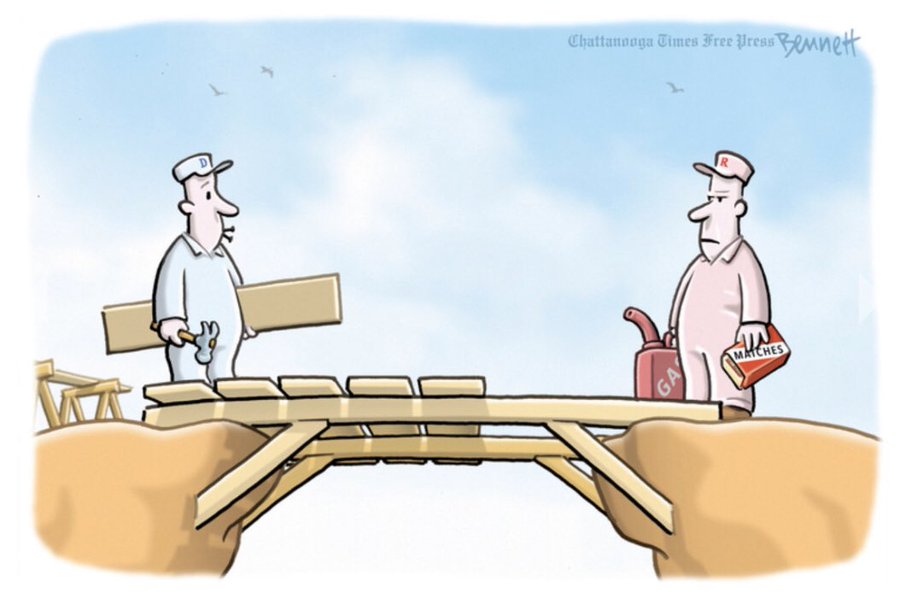
Senator Sheldon Whitehouse recently tweeted the following image. 

The message is clear: Democrats want to build bridges and Republicans want to burn them down. Because Senator Whitehouse is a politician, this declaration of moral superiority shouldn't be taken too seriously. Yes, it would be great if politicians were good people whose currency was facts, didn't disparage those who disagreed with them, and didn't exaggerate differences, but that's not the world we live in.

The problem is that so many people, Democrats and Republicans alike, believe that their side is the side of honest, good-faith, pro-unity, compromising paragons. The people I tend to agree with recognize that neither party has a monopoly on virtue or vice, but on Twitter, which is mostly Democrats, frequently declare that Democrats are saintly while Republicans are malicious, completely ignoring the continuous caravan of counter examples.

There's no question that Republicans have not been angels (the Merrick Garland stunt, the unwillingness to compromise or even put forward ideas on innumerable policies, 85% of Trump's tweets), but to disabuse the left of their misperception, here is a list to reflect on.

Starting with the courts, recall the treatment of Robert Bork. Democrat Senator Alan Cranston "urged colleagues to form a 'solid phalanx' of opposition." Senator Ted Kennedy shouted that Bork would send women to "back-alleys" for abortions, resegregate America, ban the teaching of evolution, approve of unrestricted government censorship. Neither of these sound particularly bridge-building to me. Then Democrats tried to prevent any Republican-nominated minorities from getting to the Supreme Court. First, Clarence Thomas was accused of sexual harassment after he was nominated, then for the first time in history, a nomination was blocked by way of filibuster. Most who followed the controversy believe that Estrada was blocked solely because he was Latino, and Democrats didn't want the first Latino Supreme Court Justice to have been Republican-appointed. By 2005, Democrats had filibustered 10 judges, and Republicans were ready to junk the filibuster, but both sides backed down.

On Trump's three nominees, little needs to be said.

On Trump himself, Democrats' willingness to build bridges was clear. Their initial response was to resist everything Trump, holdover bureaucrats worked against their new boss, leaks were rampant. Democrats could have won a compromise on DACA, but Dick Durbin blew up any potential compromise. Democrats filibustered Covid relief to prevent Trump a political victory before the election.

Hillary Clinton called Trump voters a basket of deplorables. Obama denigrated those who disagreed with him by saying they cling to their guns and religion, then said they're being sold a swamp of crazy. These are the nominees for President for Democrats, exemplifying how their voters feel. These are not the quotes of people trying to build bridges.

Friday, April 2, 2021

Let the Market Build EV Stations

President Biden's recent Jobs Act proposal  includes $174 billion to "win the EV market." This money will go towards supporting domestic supply chains for EVs, updating factories, and building batteries and EVs, replace 50,000 diesel transit vehicles and electrify 20% of school buses. Interestingly, it will "establish grant and incentive programs...to build a national network of 500,000 EV charges by 2030."

First some facts. There are currently 1.8 million EVs on US roads, and 100,000 charging points at 41,000 public locations. This does not include the primary way EV owners charge their car, at home. 80% of car charging takes place at the driver's homeEVs make up less than 1% of the 276 million cars in US. 

Granted, EVs make up a larger percentage (3%) of annual, new car sales, and a percentage that is expected to grow. Some experts predict there will be 35 million EVs on the road by 2030.

There's no question that there will be a need for additional charging stations as the decade progresses, but there's a huge question as to why it's necessary for the federal government to spend money to build them. To begin with, there's no market failure here; the market can solve this problem and it's done so before. There's another type of vehicle that can transport 1-5 people across roads which requires periodic replenishments of a fuel source. Unlike an EV, though, the fuel source it runs is not available in everyone's home, but must be obtained at special stations that are designed to supply it. 

There are more than 100,000 gas stations in the United States. These gas stations were built by private companies across the country to satisfy the demand for gasoline. They were a natural evolution of market forces. As more people bought cars, more people needed gasoline, so more gasoline stations were built. The stations weren't distributed evenly across the 50 states, but were distributed according to demand for them so that the current network provides enough gasoline at just the right places so that drivers can drive as they please.

This was all done without a $174 billion dollar jobs plan providing incentives and grants. There is no reason one is needed for electricity charging stations. This is contrary to Noah Smith who claims that there's private companies cannot do on their own.

The only reason one may be needed is because the market won't solve this problem as fast as some people want. I would quibble with whether that is a need, but that at least is a rationale. In fact, one could make the case that it's a good idea to front money that we know will be spent anyway, but that's only under very narrow circumstances. The fronted money must be allocated in a way to ensure that it is merely accelerating what would have already happened and not direct funds wastefully.

From Business Insider:

EVgo's Levy, who has held positions at the Department of Energy and in the Obama White House, says there are risks to building too many charging stations too quickly. Charging infrastructure needs to stay just ahead of EV ownership and demand, not drastically outpace it, he says.

That's because overbuilding can crater the economics of the charging business, he said, leading to large numbers of stations that are underutilized and unprofitable to operate.

It's a mistake that's been made in the past — with significant consequences. As part of the 2009 Recovery Act, the Department of Energy allocated $100 million in grants to a company named Ecotality to construct more than 10,000 charging stations. Four years later, Ecotality filed for bankruptcy. An audit from that year found that demand for EVs hadn't grown as quickly as anticipated, and that the majority of the commercial charging stations Ecotality had built suffered from low usage.

No one can predict the future, especially ten years out. Perhaps there will be this much demand for electric cars, but it may be significantly lower or higher. Different areas of country will have different levels of take-up. Different areas will have different propensities for short-distance travel versus long-distance travel. The former can be accommodated through at-home charging. There are a thousand questions that must be answered to know how many charging points will be needed and where they will be most beneficial. The market answers those questions. Government cannot possibly simultaneously consider all of these factors and evolve as rapidly. This is why there must be a high bar for government involvement and someone needs to consider carefully whether the benefits will outweigh the costs.

To ensure alignment with demand and supply considerations, the best way to structure this money is in the form of loans, not grants. With loans, the borrowers have a much stronger incentive to choose carefully. As the above shows, even with loans, many companies went bankrupt. Does anyone believe that throwing money at companies will lead to better results than loans? Does anyone have confidence that the government has learned from its mistakes and that it won't let political considerations cloud investment decisions? 

$174 billion comes out to more than $500 for every American. If money had to be allocated by asking each American to put in $500 to achieve these goals, how many would vote yes? What lesson should we learn from the idea that Democrats want to pass something that a majority of Americans wouldn't pay for themselves if they had to? To be sure, Americans don't think the costs will come out of their pocket; they support the proposal because the benefits are $500 and the perceived costs to them are much lower.

Thursday, March 11, 2021

Biased News - Dissection of an Article

I read the Wall Street Journal every day. In the past year, I've noticed gradual slippage of objectivity where a left-of-center viewpoint breaks through more and more. The best arguments from the left are included, while the worst arguments are excluded and not scrutinized and only weak arguments from the right-of-center are included. Because I read a lot of news, I know a lot of the right-of-center arguments and the left-of-center arguments and can tell when good and bad arguments are being used or omitted, but an article from today's Wall Street Journal is a great example.

The article is about the Protect the Right to Organize (PRO) Act. Democrats passed this in Congress with the support of 5 Republicans, but its future in the Senate looks rocky. By this fact alone, the reader (and the writers) should assume a certain strength of arguments from both sides.

The first two sentences are innocuous, "most significant change to labor law in decades", unions pressuring Biden, and the vote count. Then this:

"Backers say the legislation would be a major advancement in employer rights..." followed by "[Opponents] assailed the bill, saying it would trample on state laws and endanger the flexibility that ride-share and delivery and drivers enjoy."

Ask yourself, right now, with the little information you have, whom do you support at this point in the article? I'm obviously right of center, but the "assailers"' argument seems much narrower and weaker than the supporters--"major advancement in rights" vs. "trample on state laws" and "less flexibility" for an extremely narrow set of employers. Do these summaries of the two sides seem relatively balanced? Perhaps the writers did use the best summary for the opponents, though, let's continue.

The next paragraphs are inside baseball paragraphs and are fine. Then in the sixth paragraph, the article provides the first concrete piece from the bill: $50,000 penalties for employers who violate the National Labor Relations Act and a 10 day timeline for union-employer negotiations to commence. Since there's no context for the fine (what is the current fine, what would be the actual practical implications) and no implications of the second, my first reaction was that these actually sound reasonable and fairly innocuous.

Then the harmful impacts: makes it easier for gig workers and franchised workers to unionize. No specifics, unlike above, and no context. Plus, these are painted as positives: "easier to unionize." This would be a great time to talk about how California's legislators passed legislation that had unforeseen consequences, leading to many layoffs and then the voters overturned. Instead of saying this though, they spin it as Uber and Lyft spent $200M "allowing them to bypass a state law intended to provide...protections for drivers." 

Is this objective and informative? The reader has no idea, from the story, that the California law was problematic, and the fact that a majority of Californians, after seeing some of the effects decided to undo it was minimized by describing this as corporations winning "a victory" by spending money on a ballot measure. Can we describe the PRO Act itself as "Unions win victory after spending X million dollars electing Democrats"?

This is the most obvious example of shading news coverage according to political bias. No one should consider this description as objective and high quality journalism. I don't know how newspapers work behind the scenes, but I don't understand how editors allow this.

Next there's more inside baseball, mentioning the effect on filibuster, criticism of Biden from progressives, multiple paragraphs on unions effect on elections, and finally mention of the Reconciliation process.

There is no further discussion of the elements of the bill, and I am left thinking that either Republicans' opposition to this bill is disproportionate to the strength of their arguments or that this article is omitting a lot of details. Well, doing a search shows that it's the latter, which isn't surprising. While at this point, I don't have much trust that most news outlets will present the best right-of-center arguments, in this case NPR does describe the bill more than Wall Street Journal.

It describes five primary effects of the legislation: 1) Eradication of State Right to Work Laws 2) Outlawing company-sponsored meetings of employees to discuss unionization 3) Arbitration and mediation for first contracts 4) Outlawing the use of immigration status 5) monetary penalties.

#5 was the detail provided by Wall Street Journal's article. #1 and #2 primarily, and #3 to some degree explain why Republicans' opposition will be strong. Republicans obviously support states' rights and Right to Work laws, and the federal government coming in and nullifying laws passed in individual states would be a non-starter for Republicans. Outlawing company sponsored meetings would also be hugely problematic and calls for context in the story. Firstly, it seems like it may be a 1st amendment issue. Secondly, practically, banning employer-sponsored meetings and discussion of unionization seems a pretty radical and unnecessary way to prevent undue influence (which should be banned).

Neither of these were mentioned by the Wall Street Journal's article but are absolutely integral in understanding the opposition and the issue. They are also easily discoverable. Their absence from this story borders on negligence, but is clearly a sign of poor journalism, not just under-informing readers but attempting to bias them.

Sunday, March 7, 2021

Is Raya and the Last Dragon about 2021 America?

***Mild Spoilers for Raya and the Last Dragon***

Raya and the Last Dragon, Disney's most recent animated feature film, offers a much needed lesson for today. Its theme and message are timeless and are sorely needed in the fractured world in which it finds itself. While the moral it espouses is not new, those who practice and preach it are as endangered in our world as the dragons are in its. 

In Raya, the story begins six years after society collapses, and centuries after a war that nearly destroyed the world. Five hundred years ago, creatures called Druuns, shapeless monsters that turn living things they envelop into stone, ravaged the world, petrifying humans and dragons alike. Humans had no defense against them, but dragons had the power to fight them. Despite their magic, even the dragons succumbed. When only a handful of dragons remained, the final dragons forged their powers into a gemstone which neutralized the Druuns permanently, allowing humans to flourish again. 

No longer threatened by the Druuns nor guided by the dragons, humans behaved as humans do, splitting into factions and becoming mistrustful of others. Their world, Kumandra, splits into five countries representing the body of a dragon - fangs, spine, heart, talon, and tail. For 500 years, the tribes enjoy an uneasy peace. While they don't trust each other and are always prepared for battle, power is roughly equal across the tribes and a multilateral cold war results.

Raya's father Benja leads Heart and protects the gemstone containing the dragons' power. The story begins when Benja decides that it's time to reunite all the tribes and invites the leaders from Fang, Talon, Spine, and Tail for a state dinner in hopes that reunification will eventually develop. Raya befriends the princess of Fang, Namaari, who gives Raya a dragon necklace as a token of friendship. In return, Raya takes Namaari to see the dragon gemstone. Namaari, however, attacks Raya and calls in Fang troops, as her plan had been to befriend Raya so that Fang could capture the gemstone.

Benja immediately comes to help Raya protect the gemstone, while the other tribes' leaders arrive shortly thereafter. Benja again pushes for peace and unity, but he is shot in the leg. Immediately after, all the tribes begin fighting for the gemstone, and it falls to the ground and breaks into five pieces. The Druuns immediately reappear and resume their war on humans. Each tribal leader grabs a piece of the stone and escapes. Raya helps Benja leave, but Benja throws her into the river to save her from the Druuns shortly before he turns to stone.

The movie jumps six years into the future, as Raya tries to undo the damage from that night and bring back her father. The plot follows Raya as she seeks the last dragon who is said to have survived its battle and then to recover the pieces of the gemstone. The real challenge Raya must overcome, however, is her lack of trust. After seeing her father and his dream of unity die because he took a step towards peace and trusted others, and because she herself trusted someone who betrayed her, Raya lost any faith in people she had. Raya's arc hinges on this distrust, and she must overcome it to bring back her father and her people and unite Kumandra. 

The world today is a lot like Raya's Kumandra, especially politically. Over the past few decades, the country has become intensely tribal along political lines. Red states and blue states only begin to describe the level of animosity seen. On Twitter, on news sites' comment pages, on cable news networks, we call the other side names, ascribe to them malicious intent, attribute their motivations cynical self-interest. These forums, unfortunately, reward tribalism. The more someone calls the other side corrupt and the more extreme their language, the higher their tribe raises them. 

Another outcome of this is that even those people in the center, not wanting to fight, can't escape the frenzy. Tribalism not only strengthens the extreme elements, but it affects how we see the less extreme elements. If you're not "us" you're "them", and since you are good, "they" must be bad. Tribalism muddies our perception of people. Even though those who disagree with you may be better people than many of those who agree with you, you're pushed into thinking the opposite. We look for reasons not to trust one another.

On Twitter, I've had many disagreements with people on the other side of the political schism. I've tried immensely to keep things polite, and I've never made things personal or questioned anyone's motives or put someone down in even the mildest way. While my sparring partners have used mild personal attacks, they've never said anything egregiously insulting to me. Generally, when a personal attack is used against me (and they have all been relatively tame), I call attention to it. Half the time the reaction is to abandon it, the other half is to criticize me for being sensitive.

How Twitter reflects the conflict in Raya, though, is that it is extremely difficult to get someone on Twitter to either admit a good argument from the other side that hurts their own side, or even to admit somewhere they agree. These are obvious manifestations of tribalism, the inability to even slightly side with another tribe. Acknowledging either is a type of olive branch to the other side, an act of good-faith. To date, I have only once been the recipient, and it took multiple back and forth tweets and me digging up a quotation from a public figure which directly proved my own argument. But until I provided a direct quote, my opponent would not even acknowledge the possibility of a different interpretation. Tribalism prevented him from even entertaining the notion that there was any interpretation of an ambiguous quote other than the one he defended.

The moral of Raya, is that to be a strong, united people again, we must be able to trust others and they have to trust us. Until we are prepared to stop judging each other based on the worst actions of the worst elements and demonstrate we are worthy of trust by going out on a limb and exposing ourselves, we will continue to come apart.

The great irony is that the people who would most benefit from this lesson already believe themselves to be the paragons, to need no lessons in humanity. I'm sure you do, yourself, dear reader, so I urge you to ask yourself, and push others to ask themselves, which tribe are you in? When you're arguing with the other tribe, do you seek common ground? Do you seek to narrow the scope of disagreement or to expand it? When you disagree, do you immediately assume that the other person is ignorant, unintelligent, indoctrinated, or cruel? Do you interpret their arguments in the worst possible way or the best? Honestly answering these questions will enable you to determine how tribal you are. 

Whether you want a world where mistrust and hatred prevail and define us is a different question.